

Master the fundamentals of real estate investing and start building wealth through property investment
Real estate investment for beginners is no longer exclusive to wealthy investors or seasoned developers. Whether you’re a young professional earning your first six-figure salary or someone looking to diversify your investment portfolio, real estate investing in India presents accessible opportunities to build long-term wealth.
With property prices becoming more structured and transparent, transparent platforms making transactions easier, and the real estate market showing consistent growth, now is an ideal time to understand the fundamentals of real estate investment.
In this comprehensive guide, we’ll walk you through everything you need to know as a beginner investor: from understanding different investment vehicles and calculating ROI to identifying the best cities for investment and avoiding costly mistakes.
By the end, you’ll have a clear action plan to start your real estate investment journey.
Why Real Estate Investment Is Perfect for Beginners

Before jumping into the how-to, let’s understand why real estate investment appeals to beginners more than ever before.
First, real estate is a tangible asset. Unlike stocks or cryptocurrencies, you can visit your property, see its physical condition, and understand exactly what you own.
This transparency reduces the anxiety many beginners feel about investing in abstract financial instruments.
Second, leverage is your friend in real estate. You can own a ₹50 lakh property by investing just ₹10-15 lakh of your own money and borrowing the rest through a home loan.
This amplifies your returns significantly. If that property appreciates 20% over five years, your actual return on investment (ROI) is much higher than 20% when calculated on just your initial capital.
Third, rental income provides steady cash flow while your property appreciates in value.
Many investors use this dual approach: collecting rent monthly while waiting for property prices to rise over years.
Finally, real estate is backed by government regulations and clear ownership titles, giving you legal protection and peace of mind compared to less regulated investment avenues.
Understanding Different Real Estate Investment Types
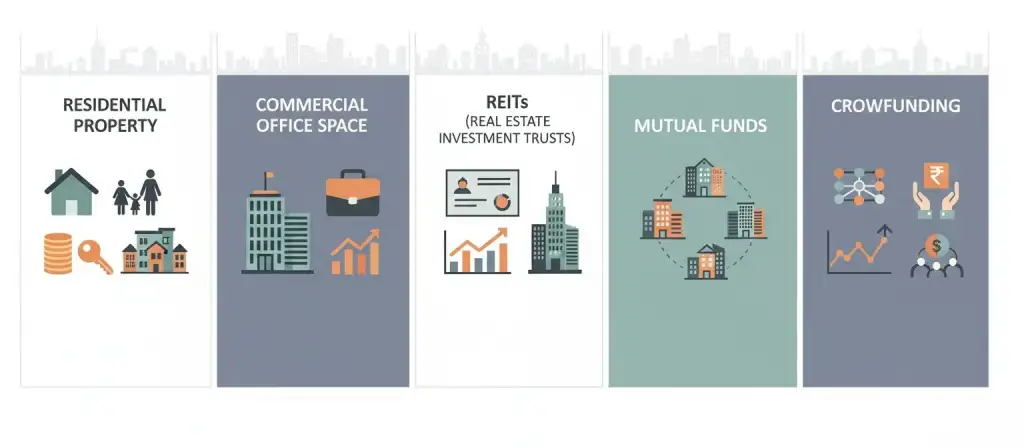
Real estate investment isn’t just about buying a property and renting it out. Beginners have multiple options, each with different risk-return profiles and capital requirements.
Let’s explore them.
Residential Property Investment
This is the most common entry point for real estate investment for beginners. You purchase an apartment, bungalow, or villa, either to live in (primary residence) or rent out (investment property).
Residential properties offer stable rental demand, especially in metro cities. However, they require significant capital upfront—typically ₹20-50 lakh minimum in tier-1 cities—and have slower appreciation compared to commercial properties.
Commercial Property Investment
Office spaces, retail shops, and warehouses fall under this category. Commercial real estate typically offers higher rental yields (6-8% annually) compared to residential (2-3%).
However, they require deeper due diligence regarding tenant quality, location accessibility for businesses, and local commercial demand. Commercial properties are better suited for investors with some real estate experience.
Real Estate Investment Trusts (REITs)
REITs are the stock market’s answer to real estate investing. They’re companies that own, operate, and finance income-generating real estate properties.

By buying REIT shares, you invest in real estate without owning physical property. Minimum investment starts from ₹500-1,000.
REITs offer liquidity (you can sell anytime), diversification, and professional management, making them ideal for cautious beginners. However, returns fluctuate with stock market sentiment.
Real Estate Mutual Funds
Similar to REITs but more diverse, real estate mutual funds invest in multiple companies within the real estate sector. Minimum investment is often ₹500, making them highly accessible for beginners.
Returns come from capital appreciation and dividends. These are less direct real estate exposure but more flexible and volatile than REITs.
Real Estate Crowdfunding
This emerging option allows multiple investors to pool capital for a single project. Platforms connect you with real estate projects in need of funding.
You get fixed returns (often 12-15% annually) or equity stakes. Minimum investment starts at ₹1 lakh on most platforms.
However, this sector is still evolving in India, and regulatory clarity is still developing.
Comparison Table: Real Estate Investment Options
As a beginner, consider your capital availability, time commitment, and risk tolerance when choosing.
Physical property ownership offers tangible control but requires significant capital and management. Securities (REITs, mutual funds) offer flexibility and lower minimums but less direct control.
Calculating Your Real Estate Investment Returns: ROI and Rental Yield

Numbers matter in real estate investment for beginners. You need to understand how to calculate returns to make informed decisions and compare properties.
Rental Yield: Your Annual Income from Rent
Rental yield tells you what percentage of your investment you earn annually through rent.
Formula: (Annual Rent ÷ Property Price) × 100. Example: A ₹50 lakh property generating ₹30,000 monthly rent means ₹3.6 lakh annually. Your rental yield is (3.6 ÷ 50) × 100 = 7.2%.
A rental yield of 4-6% is considered healthy in Indian metros, while tier-2 cities often offer 6-8%.
Return on Investment (ROI): Your Total Gain Over Time
ROI includes both rental income and property appreciation.
Formula: ((Current Value – Purchase Price + Total Rent Received) ÷ Initial Investment) × 100. Let’s say you buy a ₹50 lakh property, collect ₹10 lakh in rent over 5 years, and the property’s value increases to ₹60 lakh. Your ROI = ((60 – 50 + 10) ÷ 50) × 100 = 40% over 5 years, or 8% annualized.
This is a strong return.
Best Cities for Real Estate Investment in India Right Now
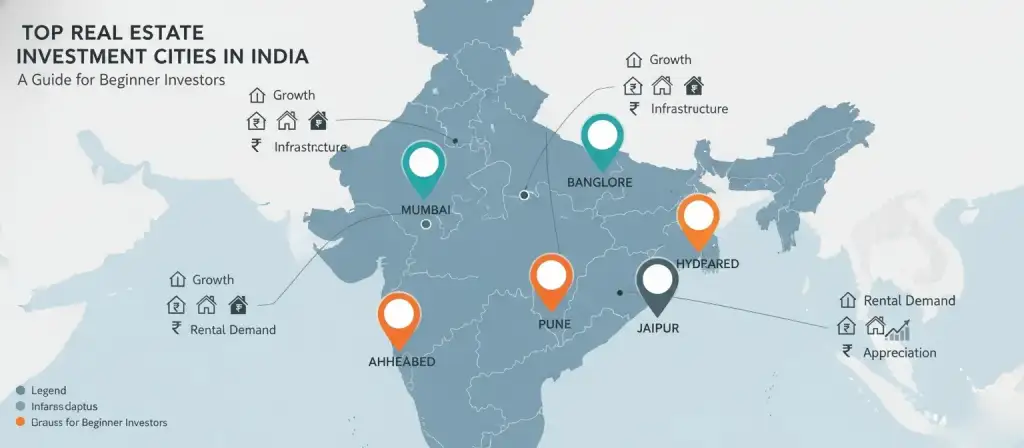
Not all Indian cities offer equal real estate investment opportunities. Your choice of location is crucial. Here’s a breakdown for beginners.
Tier-1 Cities (Mumbai, Delhi-NCR, Bangalore, Hyderabad)
These metro areas offer high rental demand, strong price appreciation, and excellent liquidity (easy to sell).
However, property prices are steep—often ₹50 lakh to ₹1+ crore for decent locations. Rental yields are lower (3-5%) because prices are already inflated. Best for investors with high capital and long-term vision.
Tier-2 Growing Cities (Pune, Ahmedabad, Jaipur, Coimbatore)
These cities are experiencing rapid growth, new jobs, infrastructure development, and young populations.
Properties here cost ₹20-40 lakh, offering good rental yields (5-7%) and appreciation potential (8-12% annually). Ideal for beginners with ₹20-30 lakh capital.
You get better value and growth prospects compared to metros.
Cities like Pune (IT hub with continuous growth), Ahmedabad (business-friendly with affordable housing), and Hyderabad’s satellite towns represent the future of Indian real estate investment for beginners.
Step-by-Step Guide to Your First Real Estate Investment
Ready to invest? Here’s exactly what to do.
Step 1: Assess Your Financial Position
Calculate how much you can invest without affecting emergency funds or short-term needs.
A good rule: invest only money you won’t need for at least 5 years.

Real estate is illiquid—selling takes 2-6 months. Determine your down payment capacity (20-30% of property price is standard) and loan eligibility from banks.
Step 2: Decide Your Investment Strategy
Are you buying for self-occupation and future appreciation? Or pure investment with rental income? Are you comfortable with growth stock-like properties in emerging cities, or do you prefer stable metropolitan locations?
This decision guides where and what you buy.
Step 3: Research and Shortlist Properties
Use platforms like 99acres, MagicBricks, Housing.com, and Propreserve.
Visit neighborhoods at different times, mornings, evenings, weekends. Talk to existing residents. Check for proximity to schools, hospitals, metros, offices.
Analyze rental rates for similar properties nearby. Don’t rush, good properties await patient investors.
Step 4: Verify Legal Documents and Red Flags
This is critical for beginner real estate investors. Hire a local property lawyer (₹10,000-20,000 fee).
Verify: title deeds and ownership history, property tax payments, no pending litigations, building permissions from municipal authorities, and environmental clearances for commercial properties.

Don’t skip this, it’s your insurance against future headaches.
Step 5: Negotiate and Make an Offer
First prices are rarely final. Offer 10-15% below asking price and negotiate from there.
Research comparable properties in the area to justify your offer. Get everything in writing, nothing verbal. Many beginners leave money on the table by not negotiating.
Step 6: Arrange Financing
Once you’ve finalized the property, apply for a home loan. Gather documents: salary certificates, last 2 years of tax returns, property documents, identity proof.
Compare rates from multiple banks—even 0.25% difference saves ₹1-2 lakh over the loan term. Lock the rate before finalizing the purchase.
Step 7: Complete the Transaction
Register the property deed, pay stamp duty and registration fees, and complete all legal formalities. Your lawyer guides you through this.
Once registered, the property is officially yours. Congratulations, you’re now a real estate investor!
Common Mistakes Beginner Real Estate Investors Make (And How to Avoid Them)
Rushing into purchase without research
Real estate FOMO is real. Don’t buy just because a builder is offering discounts or your friend invested somewhere.
Spend 2-3 months researching before committing ₹50 lakh+ of your money.
Ignoring location fundamentals
A cheap property in a declining area is not a bargain. Location determines rental demand, appreciation, and liquidity. Overpaying for a good location is often smarter than underpaying for a bad one.

Not calculating actual returns accurately
Account for maintenance costs (1-2% of property value annually), property taxes, insurance, and vacancy periods.
Many beginners quote gross rental yield without deducting these, leading to inflated expectations.
Overleveraging with home loans
Banks will approve you for loans your rental income doesn’t fully cover. Ensure your tenant’s rent exceeds your EMI. If not, you’ll need to subsidize from your salary—which defeats the purpose.
Your Real Estate Investment Journey Starts Now
Real estate investment for beginners in India is achievable and rewarding when approached methodically. You don’t need to be wealthy or have years of experience.
What you need is clarity on your goals, patience during research, and discipline to execute without shortcuts.
Start small if you’re nervous. A ₹20 lakh investment in a tier-2 city teaches you more than watching from the sidelines. Each property teaches lessons, about markets, tenants, regulations, that prepare you for bigger investments later.
Remember: Real estate is a long game. Five-year planning cycles are minimum. If you’re looking to get rich quick, stocks or crypto might feel more exciting.
But if you want steady, compounding, tangible wealth-building, real estate remains India’s most reliable path.
Your first step? Make a list of 5 cities you’re interested in, research their recent appreciation rates, and visit at least one property each month.
In three months, you’ll understand the market better than 90% of casual investors. That clarity is your competitive advantage